

1. Introduction
The Eaton PLSM-C32/2-EI is a two-pole miniature circuit breaker (MCB) designed to provide reliable protection against both overloads and short circuits in residential, commercial, and light industrial installations. Rated at 32 A with a Type C tripping characteristic, it combines a thermal bimetal element that responds to sustained overcurrent with a magnetic solenoid that trips instantly during high-current faults, ensuring fast and effective circuit disconnection. Suitable for use up to 400–440 V AC or 48 V DC, it offers a high breaking capacity of 10 kA, allowing it to safely interrupt significant fault currents without damage. Its compact DIN-rail mountable design, finger-safe IP20 terminals, and robust endurance of up to 10,000 electrical operations make it both safe and long-lasting. Built to meet IEC/EN 60898-1 standards, the PLSM-C32/2-EI is ideal for circuits with moderate inrush currents, such as those powering motors or inductive loads, providing dependable performance and protection in demanding conditions.
2. Inside an Eaton MCB PLSM-C32/2-EI
2.1 How it Protects the Circuit
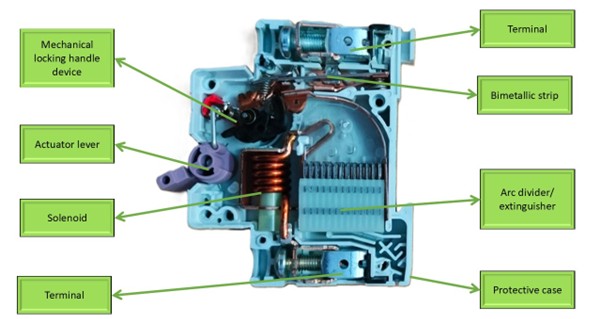
Ever wondered what’s inside a Miniature Circuit Breaker (MCB) and how it reacts instantly to electrical faults? Let’s break down its key components:
- Actuator Lever – The manual control to switch the circuit ON or OFF.
- Solenoid – An electromagnetic coil that reacts within milliseconds to short-circuits.
- Mechanical Locking Handle Device – Keeps the lever firmly in position for operational safety.
- Terminal – The connection point for incoming and outgoing wires.
- Bimetallic Strip – Senses prolonged overloads by bending under heat to trigger the trip.
- Arc Divider / Extinguisher – Splits and cools the arc, extinguishing it in microseconds.
- Protective Case – Shields all components and ensures user safety.
2.2 How it works
When an overload occurs, the bimetallic strip bends and trips the breaker. For a short-circuit, the solenoid pulls the lever instantly, breaking the circuit. The arc extinguisher safely dissipates the energy, ensuring protection for both equipment and people.
Note: Understanding these parts not only helps in electrical safety awareness but also aids engineers, electricians, and enthusiasts in better system design.